

Last Updated: November 20, 2026
Quick Summary
Pool pump motor replacement typically costs $325 to $1,025 installed for a motor-only swap, with parts running $150 to $500 and labor $100 to $300. A complete pump replacement runs higher, at $400 to $900 in parts plus $150 to $350 labor. Your final price depends on motor size, speed type, and whether you hire someone to install it.
- Motor-only swaps suit sound housings, while cracked housings or obsolete models call for complete pump replacement.
- Replace the seal every time the motor comes off the housing, even if it looks fine.
- If repair cost exceeds half a new motor's price, replace the motor instead.
- Match voltage, frame size, and flange type to the nameplate before ordering any motor.
- Ask for the motor's part number in writing so a cheaper substitute can't be slipped in.
Table of Contents
- Pool Pump Motor Replacement Cost at a Glance
- Labor Cost to Replace Pool Pump: What the Work Actually Involves
- Motor Price by Horsepower, Speed, and Voltage
- Pool Pump Motor Repair vs Replace: How to Decide
- Pool Pump Seal Kit Replacement: The $30 Part That Saves a $500 Motor
- Diagnose Before You Buy: Matching Voltage, Frame, and Flange
- Evaluate a Contractor Quote Line by Line
- Order the Right Motor for Your Pump
- Frequently Asked Questions
Pool Pump Motor Replacement Cost at a Glance
Pool pump motor replacement cost depends on three things: motor size, speed type, and whether you're paying someone to install it.
Here's the part most cost guides gloss over. The motor is rarely the biggest line item on the bill. It's the diagnosis, the seals, the labor, and the surprise plumbing work that decide whether you spend $200 or $900.
Below, we break down every variable behind a quote so you can spot a fair price from an inflated one.
Motor-Only vs. Complete Pump Replacement
A motor-only replacement swaps the electrical unit bolted to your existing pump housing. A complete pump replacement replaces the housing, impeller, diffuser, and motor as one assembly.
Motor-only replacement is often cheaper when your pump housing is sound. The catch: if the housing is cracked, the impeller is worn, or the pump is an obsolete model with hard-to-source parts, you're throwing money at a unit that will fail again soon.
The Variables Behind Every Quote
Four factors move the number more than anything else:
- Horsepower: a 0.75 HP motor costs less than a 2 HP unit
- Speed type: single-speed motors are cheaper upfront than variable-speed
- Voltage: 115V and 230V single-phase units are common; three-phase commercial motors cost more
- Flange and frame: square flange, C-frame, and threaded shaft configurations each carry different price points
| Job Type | Typical Parts Range | Typical Labor | Best For |
|---|---|---|---|
| Motor-only swap | $150-$500 | $100-$300 | Sound housing, matching motor available |
| Complete pump replacement | $400-$900 | $150-$350 | Cracked housing or obsolete model |
| Seal kit refresh | $25-$60 | $0-$150 | Motor still good, leak at seal |
Typical Labor
Labor Cost to Replace Pool Pump: What the Work Actually Involves
Labor cost to replace a pool pump depends on the job, and it's not one task. It's a sequence: shut off power at the breaker, drain and disconnect the plumbing unions, unbolt the old motor from the housing, swap the seal and gasket, mount the new motor, reconnect the wiring, prime the pump, and check for leaks.
That sequence is why a "simple motor swap" quote can climb. Two things drive labor up fast:
- Frozen or seized bolts on an older pump, which can add an hour of careful work
- Electrical corrections, if the existing wiring or breaker doesn't meet current code
Watch out: a technician who quotes a flat labor fee without asking about your pump's age or wiring is guessing. Ask what happens if the bolts seize or the wiring needs correction, and get that in writing before work starts.
Motor Price by Horsepower, Speed, and Voltage
Motor price tracks horsepower and phase configuration more than brand. A single-phase 1.5 HP motor sits in a different bracket than a three-phase commercial unit, and three-phase motors cost more because they're built for heavier duty cycles.
Here's an example from our catalog. The Pentair WhisperFlo Pump Motor, Single Speed, 1.5 HP, Three Phase is a three-phase single-speed unit priced at $546.00.
Three-phase motors aren't for every pool. They require three-phase power at the equipment pad, which most residential setups don't have. If you're unsure what your pump draws, check the nameplate before you shop.
Single-Speed vs. Variable-Speed: The Payback Math
Variable-speed motors cost more upfront, but they can run at lower RPM for much of the day, and lower RPM draws less electricity.
The math works like this: a single-speed motor runs at full speed whenever it's on. A variable-speed motor can run longer at a fraction of the speed, moving the same water for less energy. For a reader weighing the upgrade, we stock two real options that show the configuration difference:
- Century Vgreen Evo Variable Speed Motor, C Frame, 0.75 to 1.65 HP, 230V
- Century Vgreen Evo Variable Speed Motor, Square Flange, 0.75 to 1.65 HP, 230V
The C-frame and square-flange versions exist because pump housings differ. Match the flange to your existing pump or the motor won't bolt on.
Pool Pump Motor Repair vs Replace: How to Decide
Repair wins when the motor is young and the fault is a seal, gasket, or capacitor. Replace wins when the motor is old, the windings are burned, or the bearings are grinding.
A burned-out motor, one that trips the breaker immediately or smells scorched, usually isn't worth repairing.
Our rule of thumb: if the repair cost exceeds half the price of a new motor, replace it. If a technician quotes a repair close to a new motor's price, ask why.
If you're leaning toward repair, check whether a seal kit fits your pump first. The Hayward Super Pump Seal Kits, fits SP1600 and SP2600 is one option to check whether a leak is the only problem before you commit to a full motor swap.
Pool Pump Seal Kit Replacement: The $30 Part That Saves a $500 Motor
A pool pump seal kit replacement is the cheapest insurance in pool ownership. The seal keeps water away from the motor's bearings and windings. When it fails, water reaches the motor and destroys it.
The Hayward Ecostar Tristar Pump Seal Kit, SPXHKIT100 is one example of a seal kit for this type of pump.
What most guides miss: the seal should be replaced every time the motor comes off the housing, even if it looks fine. Reusing an old seal after a motor swap is the most common reason a fresh motor leaks within months.
Diagnose Before You Buy: Matching Voltage, Frame, and Flange
Diagnosis before buying parts is the step that separates a smooth replacement from a return. Three specs must match your existing motor: voltage, frame size, and flange type.
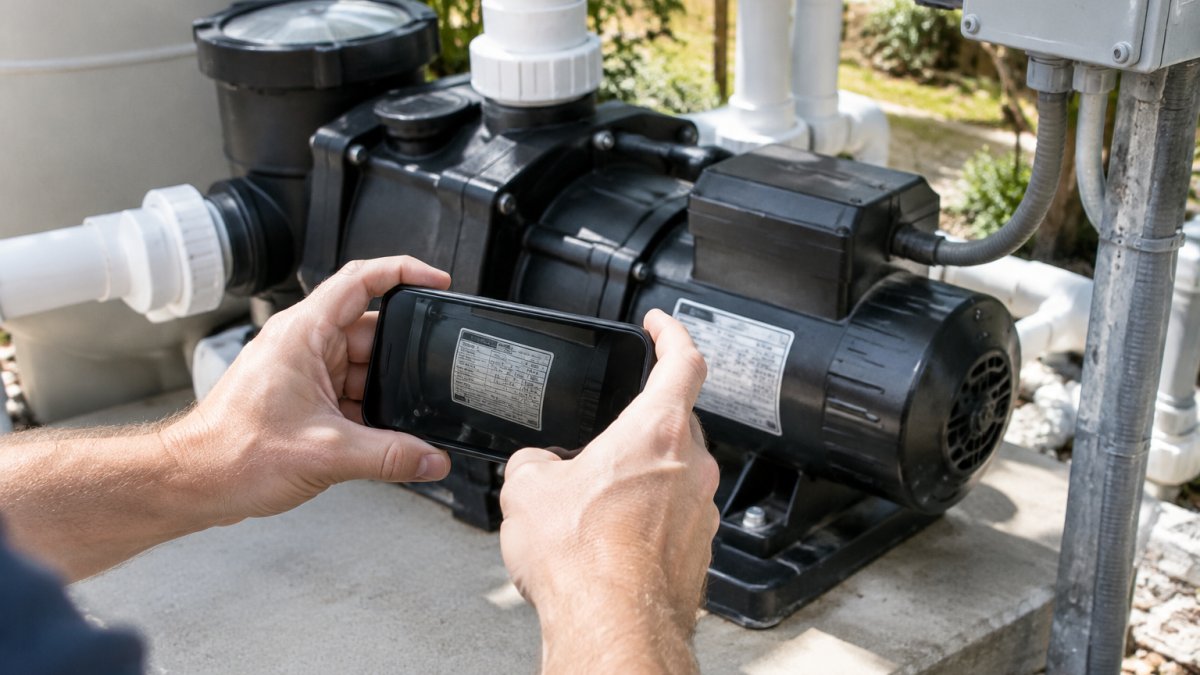
Read the motor nameplate. It lists voltage, horsepower, phase, frame, and service factor. Photograph it before you shop. Then confirm:
- Voltage matches your supply, 115V or 230V single-phase
- Frame size and shaft type match, C-frame or threaded shaft
- Flange type matches, square flange or round
- Horsepower matches the pump's design
- Enclosure type suits your setup, TEFC for outdoor pads
Get one wrong and the motor won't fit or won't run safely. Our toll-free support team can help you confirm the match before you order.
Evaluate a Contractor Quote Line by Line
A fair quote itemizes parts and labor separately. A vague quote bundles everything into one number, which makes it impossible to spot padding. The fastest way to judge a quote is to compare it against a sample itemized estimate, so here is what a realistic motor-only job looks like broken out:
| Line item | Typical range |
|---|---|
| Motor (matched to nameplate) | $150-$500 |
| Seal kit and gaskets | $25-$60 |
| Labor (1-3 hours at local rate) | $100-$300 |
| Service call / trip fee | $50-$125 |
| Disposal or recycling of old motor | $0-$40 |
| Sales tax on parts (varies by state) | applied to parts subtotal |
Add those lines and you get an installed total that commonly lands between $325 and $1,025 for a motor-only swap, which is why two quotes for the "same job" can differ by hundreds of dollars without either being dishonest. One contractor may waive the trip fee; another may charge a diagnostic fee that gets credited only if you approve the work. Ask which fees are credited and which are not.
Ask for these line items in writing:
- Motor make, model, and part number
- Seal kit and gasket cost
- Labor hours and hourly rate (not just a flat number)
- Disposal fee for the old motor
- Any electrical or plumbing scope, priced separately
Watch out: quotes that don't list the motor's part number are a red flag. You can't verify you're getting the motor you paid for, and a cheaper substitute is easy to slip in. Ask for the part number and look it up before you approve the job.
Regional and seasonal variation is real, and it follows a predictable mechanism rather than random luck. Labor rates track local cost of living and contractor availability, dense metro markets and areas with few pool technicians run higher, while markets with many competing shops run lower.
Order the Right Motor for Your Pump
Ordering the right motor comes down to matching the nameplate, not guessing by pump brand. A correctly matched motor bolts on, wires up, and runs without a return.
Here's a concrete example of what a matched replacement looks like.
At Swimming Pool Supply USA, we have over 10 years of industry experience. Orders typically arrive within three to five business days, shipping is free over $100, and our 30-day return policy applies to wrong matches. If you're unsure, call our toll-free support line before you order.
The hardest part of a pool pump motor replacement isn't the wrench work. It's matching the spec before you spend a dime.
Frequently Asked Questions
Is it cheaper to replace the pool pump motor or the whole pump?
Motor-only replacement is almost always cheaper. The catch is condition: if the pump housing is cracked, the impeller is worn, or the wet end is leaking, a new motor alone won't fix it. Inspect the housing and impeller before you order, and factor in labor either way, since both jobs take a service call.
How much does a professional charge to replace a pool pump motor?
Labor for a motor-only swap depends on your market and whether any plumbing or electrical work is needed. That figure covers draining the pump, unbolting the old motor, installing a new seal kit, and reconnecting the wiring. If the technician has to cut and re-glue PVC or correct a voltage problem, expect the labor cost to replace pool pump components to climb toward the higher end.
Can I replace a pool pump motor myself?
Yes, if you're comfortable with basic electrical work and can shut off the breaker at the panel. The job means removing four bolts, swapping the motor, replacing the seal kit, and reconnecting three wires in the right configuration. The two mistakes that cost people money are skipping the seal kit and ordering the wrong frame or voltage. Photograph the nameplate before ordering so the part number, horsepower, voltage, and frame size all match.
Does a new pool pump motor require a new seal kit?
Always. The shaft seal keeps water out of the motor's bearings, and it's a one-time-use part once compressed. Reusing an old seal is the most common reason a freshly installed motor fails within a season. A pool pump seal kit replacement is quick to do while the motor is already off. Order the kit with the motor so you're not making a second trip mid-repair.
How long does a pool pump motor typically last?
Most pool pump motors run five to twelve years depending on runtime, water chemistry, and whether the seal has been maintained. Motors that run 24/7 in a hot climate sit at the shorter end. If yours is past eight years and the bearings are noisy or the housing is corroded, replacing the motor rather than repairing it usually makes more financial sense than paying for a rebuild.
