

Quick Summary
Pool water greening is usually algae, but the cause can also be metals, pollen, or poor circulation, so diagnose first. Test free chlorine, combined chlorine, pH, alkalinity, and cyanuric acid, then balance pH before shocking the pool with a dose calculated from its volume.
- Look at a glass of pool water against white to see whether it is cloudy, slimy, or clear-green.
- Balance pH to 7.2-7.8 and total alkalinity to 80-120 ppm before shocking.
- Calculate gallons as length × width × average depth × 7.5 for a rectangular pool.
- Brush the walls, floor, steps, and waterline again a few hours after the first shock dose.
- Do not swim until free chlorine is back in range and the water is clear.
Table of Contents
- Why Pool Water Turns Green: Diagnosing the Cause First
- Why Your Pool Looks Green But the Water Is Clear
- How to Clear Green Pool Water Fast: Test, Shock and Filter
- Is It Safe to Swim in Green Pool Water?
- Frequently Asked Questions
Why Pool Water Turns Green: Diagnosing the Cause First
Last Updated: November 21, 2026
Pool water greening is usually algae, but the wrong diagnosis wastes chemicals and days. Run a short diagnostic to separate four common causes: green algae, metals (copper or iron), pollen and fine debris, and poor circulation. Each looks green from the deck but needs a different fix.
Step 1: Look at the water, not the surface. Fill a clear glass from elbow depth and hold it against a white background in daylight. Algae makes the sample cloudy and slightly slimy, with green tufts on walls, steps, or the waterline. Metals tint clear water green or brown-green without settling; pollen looks like fine dust that re-suspends when brushed.
Step 2: Test free chlorine, combined chlorine, pH, total alkalinity, and stabilizer (cyanuric acid). A 5-way strip covers most of these readings in about 30 seconds and flags the common pattern: low free chlorine with high pH.
Step 3: Rule metals in or out. If the water is clear-green and the tint appeared after a well fill, after shocking, or after raising pH, metals are a real candidate. Look for blue-green or brown stains on steps, ladders, and skimmer mouths, and check whether the color intensifies after chlorine, oxidized copper turns water green quickly. A pool-store metals test settles it.
Step 4: Check circulation and filtration before you blame chemistry. Clogged skimmer baskets, short pump run times, a filter running well above its clean pressure baseline, or return jets pointed at one wall let fine debris and dead algae hang in the water. If chemistry reads normal and the water is still hazy green, the filter and run time are the suspects.
Watch out: Do not pour in shock before you test. A high chlorine dose with unknown pH, stabilizer, or metal content can make water harder to balance, bleach a liner, or lock metals onto surfaces, and it hides the readings you need.
Once you know the cause, the treatment changes: algae needs chlorine and filtration, metals need a sequestrant and pH control, pollen needs mechanical removal, and circulation problems need filter and run-time fixes before any chemical.
Why Your Pool Looks Green But the Water Is Clear
Sometimes the water looks green on the surface but is clear in a cup held to the light. The tint may come from metals such as copper or iron, or from pollen on the surface. Algae usually makes the whole pool cloudy and slimy, not just tinted.
Check metal levels and look for wall stains. To keep debris and sunlight out of the water between seasons, you can see a heavy duty winter pool cover. If the color changes after a storm or pollen season, the cause is likely something other than algae.
How to Clear Green Pool Water Fast: Test, Shock and Filter
Fast recovery is a sequence, not a single product. Work through these stages in order, each depends on the reading from the one before.
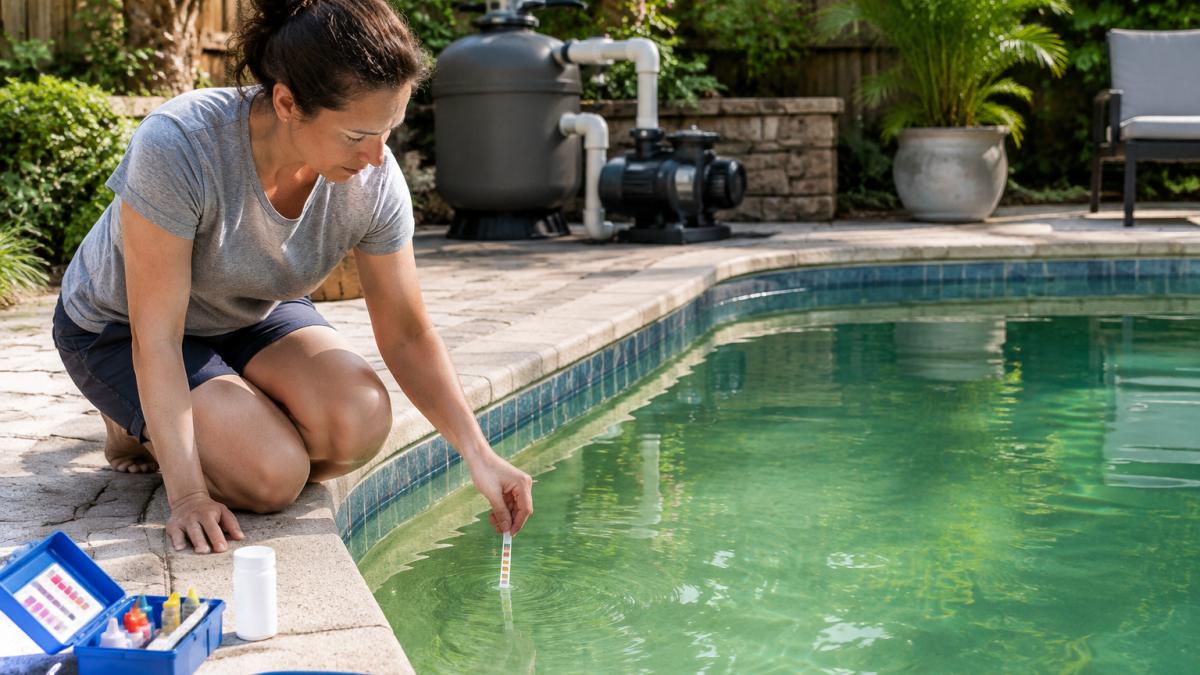
Stage 1: Get the baseline readings. Test free chlorine, combined chlorine, pH, total alkalinity, cyanuric acid, and, if you suspect repeat outbreaks, phosphates. Write the numbers down to compare after each stage.
Stage 2: Balance pH and alkalinity before you shock. Bring pH to 7.2-7.8 and total alkalinity to 80-120 ppm. Chlorine is far less effective at high pH, and shocking an out-of-range pool is the most common reason a shock "doesn't work."
Stage 3: Calculate the shock dose from pool volume, not the label's default. Measure length × width × average depth × 7.5 for a rectangular pool (× 5.9 for round) to get gallons, then follow the label's ppm-per-10,000-gallons instructions. A green-to-black bloom often needs two or three rounds spaced several hours apart, with brushing between. Liquid sodium hypochlorite adds no stabilizer, which matters if cyanuric acid is already high.
Stage 4: Brush before, during, and after. Algae forms a biofilm that shields it from chlorine. Brush walls, floor, steps, ladders, and the waterline, then brush again a few hours after the first shock dose.
Stage 5: Run the filter continuously and match the recovery step to the filter type.
- Sand filters: backwash when pressure rises above your clean baseline, then rinse. If backwashing no longer drops pressure, the bed has channeled and needs a deep clean or sand change.
- Cartridge filters: pull the cartridge, hose it inside out, and soak it in filter cleaner if greasy or scaled. Replace a cartridge that stays clogged after cleaning.
- DE filters: backwash, then recharge with the correct amount of DE for the filter's square footage. Skipping the recharge lets DE pass into the pool and defeats filtration.
Stage 6: Troubleshoot chlorine that appears ineffective. If free chlorine will not hold after shocking, check three things. First, cyanuric acid: above roughly 50-70 ppm, chlorine is increasingly buffered, and the fix is partial water replacement, not another shock. Second, chlorine demand: a heavy bloom consumes chlorine fast, so near-zero a few hours after shocking is expected, dose again. Third, testing limits: many strips read only to 10 ppm, so a shocked pool can read falsely low; use a dilution with a reagent kit for the real number.
Stage 7: Clear the dead algae. Once the water turns cloudy blue-gray, the algae is dead and the filter is doing the work. Keep filtering, brush daily, and add a clarifier only if haze persists after several days. Retest phosphates; high readings explain repeat outbreaks and are worth addressing with a phosphate remover once the bloom is dead.
Stage 8: Retest and confirm before you swim. Free chlorine back in the normal range for your stabilizer level, combined chlorine under 0.5 ppm, pH 7.2-7.8, and clear water you can see the drain through. Recovery time depends on how severe the bloom is and how consistently the filter runs.
Watch out: Do not clean the filter and then shock without recharging DE or reinstalling the cartridge, a missing or misinstalled element pushes debris back into the pool and makes the bloom look worse.
The article lays out eight recovery stages, and the table below condenses the ones with specific numbers and actions.
| Stage | What to do | Key figure |
|---|---|---|
| 2. Balance pH and alkalinity | Bring pH and total alkalinity into range before shocking | pH 7.2-7.8; alkalinity 80-120 ppm |
| 3. Calculate shock dose | Work out gallons from pool dimensions, then dose by label | Length × width × depth × 7.5 (rectangular) |
| 4. Brush | Brush walls, floor, steps and waterline, again hours after shock | Brush again a few hours after first dose |
| 5. Filter recovery | Backwash, clean or recharge the filter by type | Backwash above clean pressure baseline |
| 6. Cyanuric acid check | Partially replace water if stabilizer is too high | Problem above roughly 50-70 ppm |
| 8. Retest before swimming | Confirm chlorine, combined chlorine, pH and clarity | Combined chlorine under 0.5 ppm |
Is It Safe to Swim in Green Pool Water?
Do not swim in green water. Green water can mean chlorine is too low to kill germs, so wait until chlorine is back in range before swimming. Wait until free chlorine is back in range and the water is clear.
Retest the water the day you plan to swim. If you cannot get readings into range, call a pool professional instead of guessing.
Frequently Asked Questions
Why is my pool water green even after shocking it?
Shocking raises free chlorine, but it cannot work well if the pH is high, the cyanuric acid level is off, or the filter is not running long enough to remove dead algae. Test the water first with AquaChek 5-Way Test Strips, which check total chlorine, free chlorine, pH and total alkalinity in about 30 seconds. Balance pH and alkalinity before shocking again, and run the pump and filter continuously until the water clears.
Is it safe to swim in green pool water?
Green pool water is not safe to swim in. Algae and low sanitizer levels allow bacteria to grow, which can cause skin, eye and ear irritation or illness. Wait until free chlorine is back in the normal range, pH is balanced, and the water is clear enough to see the drain at the bottom of the pool before anyone gets in.
Can metals in pool water make it look green?
Yes. Copper can turn water green, often with a blue or teal tint, and iron can cause a greenish or brownish cast. Algae usually appears as green clouds or patches on the walls and floor, while metals stain surfaces and may not respond to shocking. If brushing and shocking do not change the color, test for metals before adding more chemicals.
